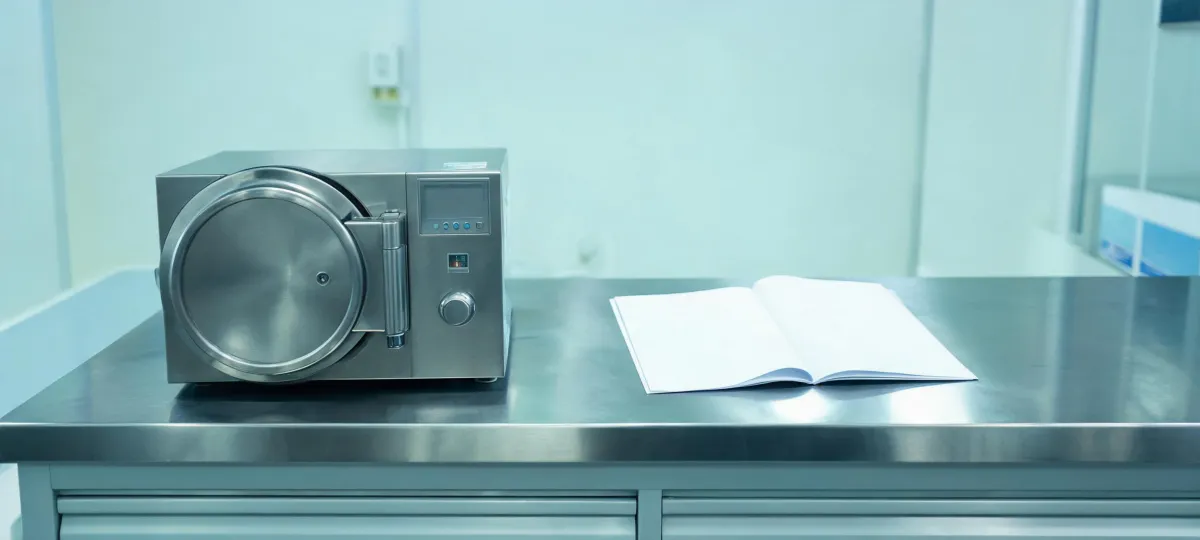
There isn't one right way to source a laboratory autoclave
I've handled capital equipment purchasing for a contract research company since 2020 — roughly $600K a year across 11 vendors, reporting to both operations and finance. I'm not a microbiologist. I don't load the chamber and I don't read biological indicators. My job ends when the unit is installed, validated, and the invoice clears without a three-email argument about whether the freight charge was on the quote.
I'm telling you that up front because most autoclave buying advice is written by people who will never have to explain a change order to a controller. And the single most useful thing I can pass on is this: there is no best way to source a laboratory autoclave. There are three situations that look identical from the outside and behave nothing alike once you're inside them.
Here's the split, based on what I've actually run into:
- One unit, one site. A single lab needs a sterilizer. You buy once every three to seven years. The timeline is weeks, not quarters.
- Standardizing across a fleet. Several departments or sites, three or more units, and someone above you has decided on "one standard model."
- Capital is tight. New is out of reach this fiscal year, so you're weighing refurbished, used, or deferring the purchase.
Each has a different failure mode, and each wants a different kind of supplier. So rather than give you one recommendation that fits about a third of the readers, here's what I'd actually do in each case.
Scenario one: you're buying a single lab autoclave
If you buy a laboratory autoclave once every few years, you have no leverage and no pattern recognition. That's fine — it just changes what you should optimize for.
Everything I'd read about equipment sourcing said to collect three quotes and go with the lowest total. In practice, on single-unit buys, price was the least predictive variable I had. The two things that decided whether we had a working sterilizer in six weeks or six months were the service response window and whether the quote included a validation package.
That second one is the one that bites. A lab autoclave machine quoted at a good price, delivered on time, and then sitting unplugged for a month because nobody priced IQ/OQ is not a good deal. It's a delay with a discount attached.
So on a single-unit purchase, I now ask these before I ask about price:
- What actually goes in the chamber? Flask sizes, biohazard bag counts, instrument trays, media volumes. Size to the load, not to the catalog page. Bigger isn't free — it costs more to run and more to validate.
- What utilities does it need? Voltage and phase, water quality if there's a steam generator, drain, ambient heat it dumps into the room, and whether the door swing clears your corridor. We once sized a unit perfectly, then discovered it wouldn't fit through the door frame.
- What's the on-site response time, in writing? Not "24/7 support." A number of hours to on-site, and whether that's actually depot return instead.
- What's in the crate versus what's extra? Printer, data logger, drain strainer, loading cart, spare gasket, accessory kit. This is where quotes stop being comparable to each other.
- Which standard does the unit claim to meet, and for which configuration?
On that last point — benchtop units sold into Europe will reference the EN 13060 classes (B, N, S), and those aren't interchangeable across every load type. Larger steam sterilizers usually point to EN 285; ISO 17665 covers moist heat sterilization more broadly; in the US, ANSI/AAMI ST79 is the guidance most hospital-adjacent labs will cite. If the device is marketed in the US for medical use, ask for the 510(k) number instead of accepting "FDA approved" on a slide.
Ask for the declaration of conformity or certificate with the model and configuration scope spelled out. A CE mark printed on a brochure page is not the same document as a DoC for the exact unit on your PO. If a supplier can't produce the scoped version, that tells you something useful.
Two more things and I'll stop. First, assume chamber volume means nothing across vendors. I learned never to assume "same specifications" meant identical geometry after a unit arrived with a door orientation that forced us to rework the room layout (this was back in 2022, and I still hear about it). Second, the quote with the 8% higher machine price and the four-hour on-site window was, honestly, the better buy. Trust me on this one.
Scenario two: you're standardizing lab autoclave equipment across sites
This is where purchasing gets political, because the person who wants standardization is rarely the person who has to live with the machine.
The conventional wisdom is to run a bake-off, pick a winner, and buy the same model everywhere. My experience with multi-site rollouts suggests that's usually the wrong goal. The units get bought, and then what actually causes problems is that Site B's staff were trained on an interface they don't have, the consumables aren't stocked locally, and the service contract has one technician covering four cities.
So the thing to standardize isn't the model. It's the interface, the consumable set, and the service agreement. If you can get one service provider, one parts catalog, and one training format across the fleet, you can survive a mixed-model fleet. The reverse isn't true — a uniform fleet sitting on four different service relationships is worse than it looks on the spreadsheet.
The failure mode nobody warns you about
We didn't have a formal handoff process between "unit delivered" and "unit released for use." That cost us. Two sites started running cycles before the operational qualification was signed off, and the paperwork landed back on my desk three weeks later to untangle. Not a disaster, just avoidable.
The third time something like that happened, I built a one-page handoff sheet — utilities confirmed, IQ/OQ documents received, staff trained, accessories inventoried, service contact posted on the machine. It takes about ten minutes per site and has saved me an estimated two weeks of chasing across the last rollout. Five minutes of verification beats five days of correction, and I say that as someone who learned it the expensive way.
One caution on standardization: don't let "one model" override the actual load profile. A site running 5-liter media flasks and a site running wrapped instrument sets don't need the same chamber. In my opinion, a mixed fleet with documented reasoning beats a uniform fleet that everyone quietly works around.
Scenario three: the budget doesn't cover new
Refurbished and used lab autoclave equipment is a legitimate path — plenty of good units get decommissioned while they still have a decade of service left. But the conversation usually gets framed around the wrong component.
Buyers ask about the chamber. The chamber is rarely what fails. What fails is the controller, the door gasket and its mechanism, the vacuum pump, the solenoid valves, and the data output. So the question isn't "how old is it" — it's "what was replaced, by whom, and is there a record."
Here's what I'd want before signing off on a refurbished unit:
- A written list of components replaced, and whether they were OEM or equivalent.
- Whether a service contract is available for that model and serial number, from someone who will actually answer the phone.
- Whether spare parts are still in production — this is the one that kills used purchases two years in.
- Who handles validation, and whether they'll do it on a non-new unit.
And one thing that isn't a purchasing question at all: if the unit supports work that gets audited, loop in whoever owns quality before you compare quotes, not after. That's not me dodging the decision — it's that the answer changes depending on their process, and I've watched a cheap refurbished unit turn into an expensive conversation because nobody asked first.
If it's a backup unit, a teaching lab, or a non-regulated prep workflow, my honest read is that refurbished is often the sensible call. If it's the only sterilizer for a regulated workflow, the risk profile is different and the savings are smaller than they look once you price the service contract into year two.
How to tell which one you're actually in
Most people I've talked to assume they're in scenario one, because that's the story they were handed: "we just need an autoclave." Here's how I'd check.
Count the units, not the request. If the answer really is one unit for one lab, you're in scenario one. If it's "one for now" but three departments are already asking, you're in scenario two and you just haven't admitted it yet. Fleet problems get much cheaper when you plan them as fleet problems from the start.
Ask who signs the validation documents. If nobody can name that person, you're in scenario two regardless of unit count. The paperwork is what makes a sterilizer usable, and it doesn't get easier at scale.
Check whether your budget is a number or a ceiling. A budget is a number you're working within. A ceiling is a constraint you're working around — and that's scenario three. If you're in scenario three, don't spend the savings on a lower purchase price and then spend it back on a service contract with a two-week response window.
Bottom line: the sourcing question isn't "which autoclave." It's "which of these three problems am I solving." Answer that first and the shortlist gets a lot shorter — usually down to two or three units, at which point the decision is about the service relationship, not the spec sheet.